
Last week, the Supreme Court made a landmark judgement in a case called For Women Scotland Ltd v The Scottish Ministers. The judges all agreed that, under the Equality Act (a law that protects people from discrimination), the words “woman” and “sex” mean biological sex — not gender identity or a changed legal status through a Gender Recognition Certificate (GRC)*.
This legal decision has major consequences for how we understand sex-based rights, trans inclusion, and the powers that the Scottish Government actually has. But it also taps into a much broader – and much older – debate: what is the difference between sex and gender? And who gets to define it?
*A GRC is a legal document in the UK that allows a transgender person to be officially recognised as their acquired gender, including changing the sex recorded on their birth certificate.
A Quick Recap: The Case Itself
Back in 2018, the Scottish Parliament passed legislation to improve gender balance on public boards, aiming for half of all members to be women. The law counted transgender women with a Gender Recognition Certificate (GRC) as part of that 50%. For Women Scotland – a gender-critical advocacy group – challenged this, arguing that the law should only count people based on their biological sex, not their legal gender. They also argued that the Scottish Government didn’t have the power to change what “woman” means in law.
The case eventually reached the Supreme Court, which decided that the Scottish Government had gone too far by trying to change the legal definition of ‘woman’ in its 2018 law. The court said this change affected the meaning of ‘sex’ as it’s defined in the Equality Act — a UK-wide law that only Westminster (not the Scottish Parliament) has the power to change. The judges made it clear that, in this legal context, ‘sex’ means someone’s biological sex, not the gender someone might legally acquire with a Gender Recognition Certificate (GRC).
The Court’s Position: Sex is Not Gender
The ruling draws a sharp line between two things many people (and policies) often blur:
- Sex: biological characteristics (chromosomes, reproductive organs etc.)
- Gender: social identity, presentation, or lived experience
The Court ruled that:
- ‘Sex’ in the Equality Act 2010 means biological sex, not gender identity.
So: A woman = biologically female, even if someone is legally recognised as female under the Gender Recognition Act (i.e., has a GRC).
This means that, in certain legal situations — like women-only spaces or targets for female representation — a person’s biological sex matters more than their gender identity.
The Academic View: It’s More Complicated
The Supreme Court gave a clear answer about what the word “woman” means in law — they said it refers to someone’s biological sex. But outside the courtroom, especially in universities and activist spaces, the idea of what it means to be a woman is a lot more complex.
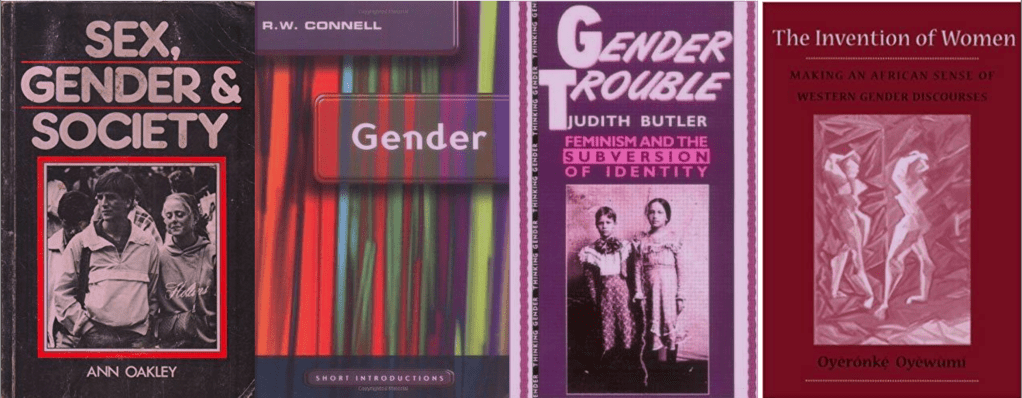
Back in the 1970s, a sociologist called Ann Oakley helped explain the difference between sex and gender. She said that sex is about biology — whether someone is male or female — while gender is about how people are expected to behave in society. In her view, being a “woman” isn’t just about your body — it’s also about how you dress, act, and are treated by others. In short, she argued that gender is something we learn, not something we’re born with.
Other thinkers took this idea even further. In the 1990s, Judith Butler argued that gender isn’t something you are, but something you do. She said that we all perform gender — through our clothes, voices, jobs, and how we act around others. These performances follow social rules, but they can also challenge those rules. She even questioned whether there’s such a thing as a “true” gender identity at all.
Sociologists Candace West and Don Zimmerman also saw gender as something people do, not something they are. They looked at everyday life and how people act in ways that show or “perform” their gender — even in small things like how we speak or behave in public.
Then, in 2007, Francine Deutch added a new twist. She asked: if we can do gender, can we also undo it? In other words, can we stop reinforcing traditional gender roles in our everyday lives? For example, what happens when men show emotion or when women take charge in male-dominated spaces? Her work suggests that gender inequality isn’t set in stone — we have the power to change it. (Personally, I find that idea hopeful.)
So, while the Supreme Court defines “woman” based on biology, many academics and activists see “woman” as a social identity — shaped by culture, experience, and personal expression. This creates a clear tension between the legal system, which needs firm definitions, and a world where identity is often more fluid and personal.
Where Theory and Law Collide
The Supreme Court wasn’t saying that people’s gender identity isn’t real or important. What it did say is that when it comes to the law — especially laws that protect people from discrimination — we need clear and consistent definitions. And in this case, the Court decided that the word “sex” means biological sex, not gender identity.
In other words, while gender and sex might be different in everyday life or academic discussions, the Court ruled that the law must stick with biology when it talks about sex.
This approach can make sense in some situations — like when governments need to collect statistics, decide who goes to which prison, or make sure there’s a certain number of women on public boards. These things often rely on physical or biological traits.
But this legal definition doesn’t match how many people and organisations understand gender today. Many believe that being a woman isn’t just about biology — it’s also about identity and lived experience. So for trans women, who identify and live as women, the Court’s ruling feels like it leaves them out. They even feel discriminated against – i.e. which toilets are they going to use?
This creates a clash between the law’s need for fixed categories and the growing public understanding that identity is more personal, complex, and diverse.
The Bigger Picture
The Supreme Court’s ruling shows a growing divide between two ways of thinking:
- The legal system: which often needs clear, either/or categories like male or female
- Academic and activist: who see gender as something more flexible — shaped by culture, experience, and individual identity
It also raises hard questions:
- Can laws that separates sex (biological) and gender (social) still protect trans people fairly?
- If rules are based only on biology, what happens to people who don’t fit neatly into traditional boxes?
That’s why opinions on this case are so divided.
Some people feel the ruling is a necessary step to protect women’s rights and bring clarity to the law. Others see it as a setback — one that could leave trans people feeling excluded and make the law feel out of touch with real-life experiences.
Final Thoughts
The conversation about sex and gender isn’t just academic — it affects real people, real policies, and everyday life. The UK Supreme Court’s recent decision shows that the law doesn’t always keep pace with how society’s views are changing.
While many people today see gender as something personal and flexible, the Court chose a more traditional, fixed definition based on biology. That decision may bring clarity in some areas, but it also highlights just how different legal and social ideas about gender have become.
It’s still unclear whether this ruling will settle the debate or add more fuel to it. But one thing is clear: the question “What is a woman?” remains one of the most complicated — and most fiercely debated — issues in our society today.
References
For Women Scotland Ltd v The Scottish Ministers [2024] UKSC 38
Available at: https://www.supremecourt.uk/cases/uksc-2022-0070.html
Butler, J. (1999). Gender Trouble: Feminism and the Subversion of Identity (2nd ed.). New York: Routledge. (Original work published 1990)
Deutch, F. M. (2007). Undoing Gender. Gender & Society, 21(1), 106–127. https://doi.org/10.1177/0891243206293577
Oakley, A. (1972). Sex, Gender and Society. London: Temple Smith.
West, C., & Zimmerman, D. H. (1987). Doing Gender. Gender & Society, 1(2), 125–151. https://doi.org/10.1177/0891243287001002002
https://www.theguardian.com/commentisfree/2025/apr/16/supreme-court-definition-woman-judges-law

 THE SECOND THOUGHT
Leave a comment